
Dear Reader,
This week I started a new project called #20Tuesdays. I’ve been working on it for a while and I’m excited to share it with you. Every Tuesday until election day I’ll be sharing one short lesson from Hannah Arendt’s The Origins of Totalitarianism. You can sign-up for that newsletter separately here.

I recently discovered the work of Yōko Ogawa. In Blackwell’s there is a wall of wrapped books, and I chose this one because it promised an experince of mathematical beauty—a concept that has eluded me, but an experience that I am intent on having. It’s an incredibly tender book that felt like a masterclass on the idea of Chekhov's Gun.
If you click on the picture below it will take you to the book.

When I finished I wanted more, so I read The Memory Police, which is tender in a different sort of way. In our world of appearances this work chronicles a dystopian state of disappearances. Perfect if you want to read something beautiful and politically timely, but not expressly so.

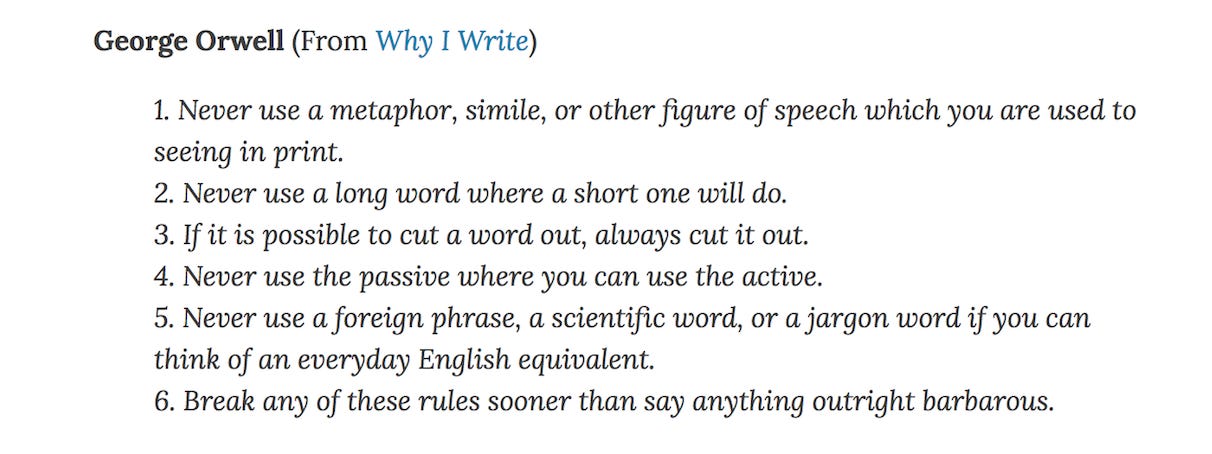
And for fun, here is some writing advice from George Orwell:
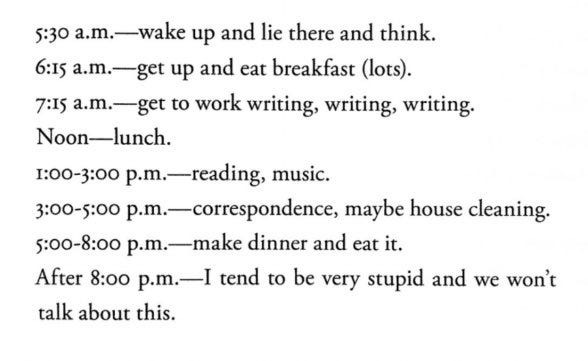
And Ursula K Le Guin's daily writing routine:
Until soon,
Sam
July Course: Hannah Arendt: The Human Condition
Enroll here.

What does it mean to be human in the world today? Hannah Arendt’s The Human Condition (1958) is a provocative treatise on what it means to live on earth and share the world in common. Her study, originally intended to be titled Amor Mundi (Love of the World), investigates the central activities of human life—labor, work, action—and their corresponding realms—private, social, public. For Arendt, The Human Condition is about protecting spaces of freedom and the ways in which we move through the world. Beginning with man’s exploration of space in the 1950s, Arendt is concerned with the ways in which modern technologies are alienating people from the world held in common. From the triumph of labor over work, to the need for promises and forgiveness, Arendt offers us an understanding of what it means to be human in the world today.
In this class we will consider Arendt’s central claims in the context of our own time, in which the distinction between private and public is being progressively erased. Arendt’s insistence that we must “stop and think what we are doing” only becomes timelier in an era of technological bombardment, fake news, and the sense of worldly alienation that so many feel in the face of increasing privatization. We will read the entirety of The Human Condition, and consider the relationships between scientific advancement, earthliness, and worldliness as we explore the realms of labor, work, and action. Along the way, we will confront foundational questions regarding forms of political action and ask: Are there essential characteristics of human life today? In what ways do science and technology both facilitate and undermine our capacity for care, thinking, and judgment? Can love be political? And what does it mean to be at home in the world?
As much as I like looking forward to Tuesdays, I am very happy to have my expectations for Sunday back as well (set by reading your notes years ago in Amor Mundi).
I have decided to read The Memory Police first. My most recent favorite of novels set in Japan is Ishiguro's An Artist of the Floating World, Ishiguro's first novel, which might be described as about a recovery from totalitarianism.
Just learned that Ishiguro's favorite Dylan song, selected for Desert Island discs, is 'Tryin' to Get to Heaven...
As always, I will be looking forward to you photographs on X.
Oh! Thank you, Terry! Please let me know what you of The Memory Police! Will post. Yours, Sam